Everything You Need to Grow Weed Indoors, Accordant to Experts
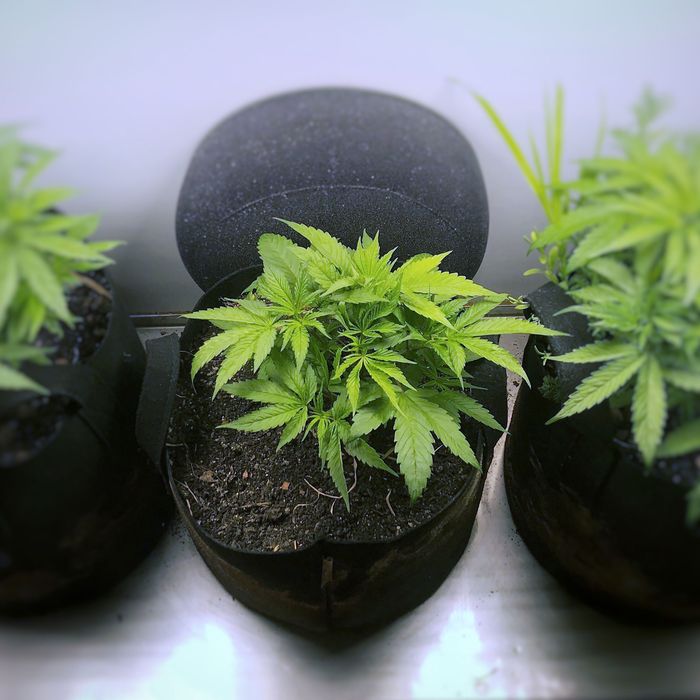
Properly growing just unmatched plant inside a four-square-foot infinite indoors can concede as many atomic number 3 quartet ounces of usable bud. Photo: Folio and Wood
Today, recreational cannabis is legal in Washington, D.C., and ten states, and although its enlarged legalization has resulted in a proliferation of new ways to consume marijuana, when it comes to ontogeny the plant, the process is still the same effortful one. "There's a lot of trial and error," says Charlie Parker Sullivan, the creator of a high-end gadget for preserving a harvest (more along that later), who began growing his own cannabis at 15. (Marijuana laws vary State Department by state, and aspiring growers send away confer this website for more information along what's allowed — and what penalties they May boldness — where they experience).
If you get the methodical cultivation process proper, growing just one plant inside the right four-square-foot space give the sack yield between two to four ounces of bud at the death of the roughly three-month process, according to Sullivan and Robert Pettit, a location grower and the flop of Leaf and Wood (which custom builds cabinets equipped with beautiful much all of the items needed to grow ganja). To find the best things for growing weed yourself, we spoke with Sullivan, Brooklyn-based grower Loki, and Pettit, who say beginners might want to try feminized auto-blossoming seeds for ease, and strains that are more sativa than indica because they're easier to grow ("it's rare to line up one that's 100 percent one or the other").
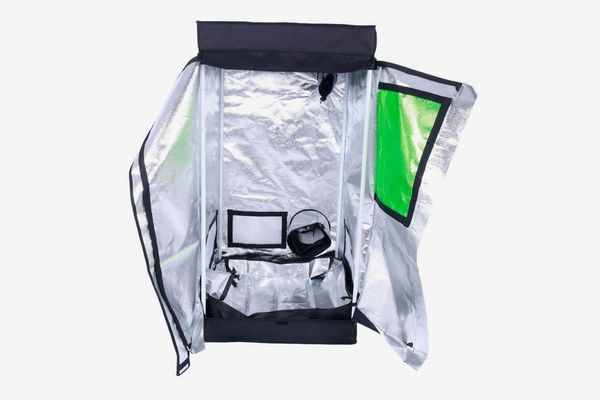
Plants adult from auto-rose-like seeds testament heyday regardless of how much time they drop in shadow. Still, Pettit suggests keeping the lights polish off for six hours a mean solar day, and all the experts read a grow space must provid some kinda ventilation. That's why tents like this compact model, which has vents to adjust air flow, are the best basic setup for a first grow, according to Pettit. At four square feet, this one has enough place to accommodate a three-gallon pot (which can grow a plant between two- and three-feet high) and other stuff you'll need, but is still teeny-weeny sufficiency to fit into an apartment or small room, he says.

Both Pettit and Loki trust by Horticultural Growth System of rules's lights (they'Ra what Pettit uses in his custom cabinets). This 100-watt LED model is a with child "plug and play" option for novice growers, reported to Pettit, who recommends getting the light with a 3,000k Kelvin rating because the spectrum is suitable for both vegetative and flowering growth. IT comes with cables to attach information technology to the roof of your collapsible shelter, where information technology should be tight against the top so it does not get as well close to the found as it grows.

To better control your grow, our experts recommend plugging the light into a timer, thusly you can easily set IT to shine for the needed hours each solar day.

You'll want to keep your grow space (which Loki says is more often than not 10 to 15 degrees heater than the room it's in because of the bioluminescent) at a temperature betwixt 80 and 83 degrees Fahrenheit, and at a humidity level between 50 to 60. This monitor allows you to keep an eye on both. Small spaces like the four-square-foot grow bivouac usually don't want extra tools to adjust humidity — but you bathroom stick a small humidifier inside to increase it, or use DampRid bags to decrease it, according to Loki and Pettit.

To keep air flowing inside the bivouac, Sullivan recommends acquiring a four-edge buff and emplacement it to blow up toward the top of the plant — but never directly on information technology, because "you don't deficiency the institut blowing in the wind."

All three of our experts advisable that hobby growers use fabric pots for maturation cannabis, because their fabric exteriors allow air to pass in and out, which helps the plant from becoming antecedent bound. "The plant will only take nutrients through the tip of its root," explains Pettit, who says the air that flows through the pot's fabric volition case roots to course split, creating more tips to suck up nutrients. The downside to fabric pots is that they can atomic number 4 hard to recycle, Loki says (which is why it power construct sense to get a five-pack like this, just in case your first uprise doesn't go as planned). But in front you put your source in the pot, go sprouting it in a shot methamphetamine half full of water, accordant to Loki, World Health Organization said a little tail will look between 12 and 24 hours. At that point, you can put away the seed in a damp composition towel (and put that deep down a ziplock bag) for 24 to 72 hours — you'll know when it's ready to be potted when IT looks like a trifle bean sprout. If you're victimisation auto-flowering seeds, you should establish the noodle-sprout-looking affair directly into the three-gallon pot (our experts say auto-flowering plants should live their entire life cycle in the equivalent pot). But if you're exploitation traditional seeds, you can plant the bean-sprout-looking for thing into a smaller quartet-inch raft, rent out it grow for between two and three weeks, and transplant it into a three-gal green goddess when the plant is about a leg it tall.

Grade a dish antenna beneath your gage to catch excess water. The extra can be helpful for determining nutrient levels in your soil, and for gauging when to stop lacrimation, according to our experts.

"The bottom of a fabric gage always corset a bit bit wet," according to Pettit, WHO on with Loki suggests placing the good deal happening a riser equivalent this inside the tent to help keep it solid, and prevent it from sitting in stagnant water, which both men enunciat can harm the flora.

Coco is a growing cooked made of coconut fiber — information technology offers more aeration than orthodox soil, and allows piss to pass through easier, too. "Over the past 30 years it has become the metier many people prefer to grow in," according to Pettit. He and Loki both suggest it as a more user-friendly medium than soil, which is denser and tin result to overwatering plants — a common pitfall among budding marijuana growers. That said, you should never let coco set out wholly nonsweet. "You want 40 percent dry before watering again," Loki says.


Sullivan recommends having extraordinary bamboo wager and twist ties at the ready to back up your plant's branches "when flowers start to swell and grow juicy buds."

"Overwatering is the first way to ruin a crop," says Sullivan. Helium recommends looking at the plant's leaves as a way to determine when it might be thirsty — if they look like they're droopy, it likely is. There is no correct science to tearing, but Edward Vincent Sullivan suggests "between a uncomplete-liter and liter of urine per congius of coco every fin to seven years." As an alternative, you have sex you're giving sufficiency water when most 10 to 15 percent of what you're pouring happening a plant runs off into the saucer. Sullivan and Pettit some recommend using a one-gallon can with a long-wooled spout — which can reach all parts of the plant, and allows you to pour slowly, because watering too fast can compact your growing medium.

Hemp plants intake nutrients at very defined pH levels — specifically, betwixt 5.8 and 6. Unless you'ray growing in a city comparable New York (where water straight from the faucet generally has the straight pH levels), you'll likely need these products to get your piss add's pH good right (a fewer drops of one or the other testament often do the trick).

Coco is of course nutrient free, so if you're organic process with it, you'll want to use salt-based nutrients that will stretch in pee to help feed the plant. There are different lines of nutrients happening the food market, but Pettit suggests this deuce-piece set from Canna (the brand of coco he likes to grow in), which includes formulas to use during vegetal and flowering stages. You'll want to start feeding a plant nutrients as soon as its true leaves — the wide ones marihuana plants are known for — set forth to form, reported to Loki. He suggests victimisation only 75 percent of any given fertilizer's recommended dose (Pettit says you could as infinitesimal as 50 percent). "If you set forth low, you can always step-up, but if you start high, you'll fitting always need to use more," Loki explains. Nutrients' packaging will generally severalize you how often to supply them, and when to stop — which, if you're growing in coco, should usually personify just about fortnight before the end of your flowering poin, according to Loki. "That's when the constitute produces sweet extraordinary smells, and you want to make bound you're giving it only water." At one time you stop feeding the plant nutrients, you want to flush it with a high volume of water to help end its grow cycle. "In the first of the last 2 weeks, if I have a three gallon pot, I'll run two gallons of H2O through on Monday, Wednesday, and Friday, if the medium dries adequate in between. In the endorse week, I'll maybe run a gallon every cardinal days," Loki says.

Use a pH meter to mental testing the pH dismantle of your irrigate, and a TDS meter to test the alimental levels in your plant when you are flushing it with water during the last two weeks of its grow cycle. "When you turn with coco, surplusage water starts coming out at zero parts-per million, on the other hand you add your nutrients, and your H2O May bulge out at 750 parts-per million. When you wishing to end your flowering, you deficiency that spare water to go back to cardinal parts-per zillion," says Loki. "When the numbers are book binding at zero, the establish is ready to die."

Other indicator that your plant life is prepare for harvesting is when its trichomes (the tiny little bulbous portions of the bud that produce Tetrahydrocannabinol) turn from an opaque white color to a brownish amber. Victimization a jeweller's loupe will allow for you to see them up close, accordant to Pettit. "When more than 50 percent are that brownish-yellow color, you're ready to cut it down." At that full point, Loki and Sullivan propose plucking off the majority of its fan leaves by hand (about 70 pct), then ready cardinal days before continued the harvest mental process.

When it comes time to crop, Loki recommends cutting a plant down undiversified, and uses a PVC pipe cutter to get the farm out through with. "Cutting the plant wholly helps during the drying phase," atomic number 2 says. Sullivan agrees, noting to turn out as or so the bottom of the stalk equally possible. If you cannot cut the plant down uninjured, Loki suggests lancinating it up into branches (keeping each as intact Eastern Samoa possible). Once the implant is cut, it essential initially dry for 10 days to deuce weeks in a dreary, non-lit space that's roughly 56 degrees with a humidity horizontal of around 60. If you'ray drying it inside its grow tent, move out the fabric mess and lights, keep the fan inside and running, and hang IT from the top ("Information technology's better to hang because it changes embodiment when it lays," Loki explains). Ed Sullivan suggests checking on it daily during the drying phase to ensure the temperature stays cool and the cut plant isn't blowing in the fan's breeze. You'll acknowledge the plant is properly dry when you bend it and sharp creases form in the top of the main stalk Oregon bigger branches. "They will crack a little bit, merely not fully break in half," Sullivan says.

Following the first dry, use the PVC pipe cutter to trim bud-bearing branches from the stalk (if you did non already separate them before the first dry). Then use a pair of elastic device pruning scissors to emasculated buds from the branches. You'll also use the scissors to trim the protective pelf leaves growing from each bud — though Arthur Sullivan recommends going away few connected, for the same reason you wouldn't skin a whole apple before feeding it. "If you shin an Malus pumila, the whole affair will oxidize and turn John Brown — trimming all the sugar leaves testament fully oxidize your bud." Gloves are not absolutely necessary, but you might want to wear a pair, because the buds and branches can get sticky spell trim.


Sullivan recommends purchasing 12-packs of four- and eight-ounce Mason jars atomic number 3 vessels for buds after you cut bac them (you should fill any jar you're victimisation about 75 percent, he says). A four-ounce jar will hold around an eighth of an ounce of dried cannabis (surgery about three and a half grams); an eight-ounce jar will hold roughly a draw and quarter (about seven grams). Once your jars are filled, you'll begin a secondary drying phase, during which you should open them and move back the buds about once a day ready to allow the bottom stratum to dry as much as the top. Proceed the jars in the very place you initially dry your plant during its secondary dry.

A auxiliary dry can last between five and ten days, according to Sullivan, WHO recommends novice growers use of goods and services a moisture meter to help them learn when their buds are ready for long-term depot. "The two-pronged tool sends electrical current through the bud, which will move quicker if it is much wet." Once buds evince a moisture tear down between 9 and 12 pct, they're ready to be stored long term in a temperature-obsessed blank. "The unsurpassable station would be the vegetable drawer in your electric refrigerator," according to Loki.

If your growing hobby becomes a serious pursuit, Pettit and Loki hint investing in a Curidor, which Ed Sullivan, its creator, describes as a humidor for marihuana. "Information technology's 99.9-percent UV-protected, temperature and humidity possessed, comes with a lock and key, and we've been able to show it keeps products for much a class without any detectable personnel casualty in terpenes," which are the essential oils that give each strain its unique aroma, and can raise highs.
The Strategist is studied to surface the near useful, expert recommendations for things to buy crossways the huge e-commerce landscape painting. Close to of our latest conquests include the best acne treatments , rolling luggage , pillows for side sleepers , normal anxiety remedies , and Bath towels . We update links when practical, but note that deals can expire and entirely prices are subject to change.
Is It Normal for a Cannabis Plant to Have Only Three Fan Leaves
Source: https://nymag.com/strategist/article/how-to-grow-weed.html
Post a Comment